Discover your all-in-one digital freight platform
Escape the chaos of calls, faxes, and endless emails. Step into a connected world where suppliers, shippers, customs, ports, and more unite on a single platform for seamless, contextual collaboration

Being an IATA accredited agent we have access to over 121 airlines, this includes scheduled freighters and passenger aircrafts.
With our LCL service, you can ship as little or as much as you like, weekly consoles are our business and get you yours.
We provide comprehensive road freight services, covering both Less-Than-Truckload (LTL) and Full-Truckload (FTL) options.
To meet your requirements we have access to vehicles of all sizes from small vans to artic with 24/7 availability and live tracking.
Escape the chaos of calls, faxes, and endless emails. Step into a connected world where suppliers, shippers, customs, ports, and more unite on a single platform for seamless, contextual collaboration
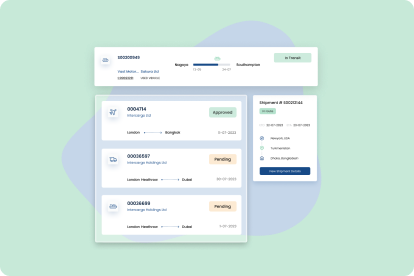
Our solutions are tailored to fit your business and its unique workflows, offering real-time order tracking from placement to delivery. Stay informed with up-to-date order statuses, track progress, and receive timely notifications for key milestones, whether shipping by air, sea, or road.

For packages requiring urgent delivery that can be achieved by road to destinations in the UK or mainland Europe, you can rely on Intercargo to deliver direct in the fastest time possible.

Get to know more about values, knowledge and experience, quickly download our company profile.


2026: Prepare to be punished by 'lazy logistics' - The Loadstar
For years, logistics companies comforted themselves with a simple belief: if you have capacity, volumes will follow. In 2026, that belief finally collapses. This year will not be defined by a single shock, a single regulation, or a single geopolitical headline. Instead, it will be shaped by something more dangerous for incumbents: structural fatigue. Customers are tired of excuses, carriers are tired of volatility, and 3PLs are tired of pretending that yesterday's playbook still works.
Source: theloadstar.com
Read more
Cathay Cargo looks forward to A350Fs and perishables growth
Cathay Cargo is looking forward to growing its capacity with Airbus A350 freighters as well as developing its perishables business. The Hong Kong-based cargo arm of Cathay Pacific benefits from ample belly capacity in its fleet, with more passenger aircraft due to arrive this year, but has more limited freighter capacity. Of 179 own-controlled aircraft in total, 20 are freighters, all Boeing 747Fs. Therefore, the additional capacity from the six A350Fs ordered from Airbus in December 2023, alongside rights for 20 more units, will provide vital support on busy routes out of Hong Kong, explains James Evans, general manager, Cargo Commercial Cathay Cargo. "We've got huge capacity in our bellies, but we've only got 20 freighters," points out Evans. The A350F was a logical choice for Cathay. The carrier already has 47 A350s of the passenger type. The arrival of the A350Fs will be a welcome step up in terms of modernisation. Cathay's six 747-400ERFs are all owned and have an average age of 14.5 years, while its 747-8Fs have an average age of 10.4 years. The 747-400s will be nearing 20 years of age when deliveries of the A350Fs, already pushed back, are due to start. The A350Fs will offer a payload capacity of up to 111 tonnes and a range of 4,700 nautical miles, as well as up to 40% lower fuel burn and CO₂ emissions compared to older in-service freighters. However, Cathay's first freighter variant won't be delivered until at least 2028, with deliveries due to continue through 2029. "In terms of our freighter capacity, we've got a steady state, or a pinch from now until deliveries begin," says Evans. While there has been speculation about a widebody cargo capacity shortage stemming from supply chain parts shortages, feedstock shortages for conversions and delays to new generation aircraft entering the market, Cathay has no current plans to lease freighters ahead of the A350F's entry into market. But the airline hasn't completely ruled out adding capacity as a stopgap, should the need arise, says Evans. "We'd always be on the lookout for opportunities like that, but right now, our focus is on getting ready for the A350 freighters. "We're always keeping a close eye on how the market is changing. But ACMI rates have been quite high and our focus is very much on optimising the capacity and network we've got." He adds: "We are looking at the 2030 horizon now as part of the next five-year plan, and obviously those A350Fs are a big part of that, and they are a growth aircraft. And then we'll need to see how we can plan our capacity needs into the next decade." Cathay is well used to efficiently managing capacity. Six years ago, operations were curtailed by government-imposed pandemic lockdown and quarantine restrictions that severely restricted passenger flights and belly capacity. "Passenger capacity was down to 2% for quite some time. Our freighters were the workhorses, and we were operating cargo-only passenger flights," recalls Evans. In the following years, the airline has gone from strength to strength. Cathay Cargo's 2025 volumes were up 9.4% year on year as it benefited from solid demand for specialist cargo handling throughout the year, as well as a stronger than expected peak season. According to Evans, Cathay Cargo is seeing healthy demand out of its home hub at Hong Kong International Airport (HKG). The airport is a regional transhipment hub and air logistics gateway to the Guangdong-Hong Kong-Macao Greater Bay Area (GBA), and strong production and export demand will see Cathay's home market continue to grow, says Evans. "There are huge volumes and business out of the Greater Bay Area. Hong Kong sits at the heart of that," says Evans. Cathay Cargo is well positioned to benefit as its current passenger and freighter fleet gives it between 25% to 30% of the total capacity share out of Hong Kong. The airline also benefits from Hong Kong's role as a transit hub for air cargo out of Southeast Asia, which is seeing increased production and strong air cargo capacity demand. "There has been double-digit growth out of Southeast Asia and we've been beneficiaries of that as well," says Evans. Demand out of Hong Kong, the GBA and Southeast Asia combined has helped Cathay maintain high freighter load factors to the Americas, including Mexico. "Our capacity to the Americas has held pretty consistent," confirms Evans. He points out that air cargo demand can quickly move from area to area, so agility is needed but Cathay is always prepared to shift its capacity. "With planes, you're lucky that you can redeploy to where the capacity is needed. You need to be able to be in a position to pivot and adjust." For example, Hanoi capacity was increased in the fourth quarter and flights to Madrid also took place during the peak season. But, says Evans: "We will continue to operate the vast majority of our freighter capacity into the Americas. We operate anywhere between 33 to 38 flights a week and sometimes increase that in the peak season. "We also look at how we can optimise the fleet and complement flights with more network support feeding on to those lanes." The stability of capacity to the US is an interesting topic, given the reduced e-commerce demand on the transpacific trade lane last year after the US decision to end the de minimis exemption. Speaking about the initial reduction in e-commerce volumes from Asia to the US, Evans says that while Cathay did "have a hit on the Americas lane", as an airline Cathay saw plenty of business on its Asia-Europe and Asia-Middle East routes and was able to move capacity accordingly. He adds: "E-commerce doesn't only go to North America, it goes to the Middle East and Europe. We've seen growth in e-commerce as a result of where platforms are trying to grow their businesses." Moreover, Asia-US e-commerce trade has now largely recovered, and e-commerce is just one commodity within a wide range of goods transported by Cathay Cargo. Cathay Cargo's fresh service will continue to be developed to grow perishables business supported by the Air-Land Fresh Lane, opened last year, to improve the efficiency of moving goods across the Hong Kong-Zhuhai-Macao Bridge (HZMB). In fact, Cathay was the first airline to utilise the lane, developed by the governments of Guangdong and Hong Kong SAR to facilitate the efficient cross-border movement of perishable goods. The initiative allows fruit and live or chilled seafood arriving at HKG to be transported seamlessly into the GBA via temperature-controlled trucks equipped with GPS tracking and accredited e-locks, all under a single air waybill. Fresh is one vertical in particular where Cathay Cargo is confident there will be volume growth. "We see the air-land, fresh lane out of Hong Kong into the GBA as a great opportunity. The GBA is a big consumption market," Evans says. "We're very bullish on those opportunities and glad that we've hit these milestones with working with the key stakeholders, including Hong Kong Airport." Last September, Cathay completed trial shipments of live lobsters and geoducks, a type of shellfish. Alongside this, Cathay is refining terminal handling, trucking and logistics integration, cross-border arrangements and end-to-end documentation. It is also building intermodal network capacity through trucking into and out of the GBA. This year, Evans says: "The Hong Kong, GBA home market is really important. Building on these trials and growing intermodal connectivity into and out of the GBA is a big focus for us." Cathy Cargo has also seen "significant tonnage growth in expert and pharma" and will continue to look at those opportunities, says Evans. Digitalisation will also be essential to support the development of intermodal services for fresh products, as well as other specialist business. Last month was the implementation deadline for IATA's ONE Record, designed to make shipment information relevant to stakeholders visible and accessible before, during and after the transport process. In December 2024, Cathay Cargo became the first carrier to adopt the IATA ONE Record data protocol in some of its operations with forwarders. The forwarders started exchanging electronic air waybill (eAWB) and shipment status information with Cathay Cargo using an application programme interface (API) designed to ONE Record data protocols. Then, in January 2025, Sinotrans Hong Kong Air Transportation Development became the first Hong Kong forwarder to submit eAWB information and was able to review shipment information from Cathay Cargo using ONE Record data protocols. In October last year, Cathay Cargo also began using the IATA ONE Record data protocol to offer real-time customs clearance updates for customers, another first for the industry and an important step in reducing reliance on manual ground handling updates and minimising congestion. The service enables customs status updates from authorities, including Europe (ICS2 Import Control System), the US, Canada and UAE. Initially, the service was available to Cathay Cargo customers subscribed to the EzyCargo platform or those with ONE Record API links, but it is being rolled out for other customers this year. Overall, Evans is confident in its capacity offering and business growth in 2026. "I remain positive for next year, partly because of the scale of the capacity we have and the location and our ability to pivot quite quickly, and the indicators from our big customers about what BSA (block space agreement) levels they they're looking at," he says. "Cathay Cargo's carrying capacity is going to grow in the 5-7% range. So not the same steep growth curve that we've seen in previous years as we came out of the pandemic, but there's still good capacity growth. That's mainly through the passenger bellies. "That gives us lots of network opportunities to feed on, and so we're really looking at optimising our capacity.
Source: aircargonews.net
Read more
Qatar Airways Cargo exercises agility in changing market
Qatar Airways Cargo anticipates a widebody capacity shortage as Southeast Asian demand continues robust growth amidst a challenging operating environment Qatar Airways Cargo is exercising its ability to rapidly adjust to an ever-evolving airfreight market. Tariffs, the end of the de minimis exemption and ongoing geopolitical conflict have made for an extraordinarily challenging 2025. But alongside navigating all the issues that have made uncertainty the new normal, the core topic of air cargo demand and capacity is always at the forefront of the Qatar Airways Cargo team's collective mind. Questioned about whether there'll be any surprises when it comes to demand next year, Qatar Airways chief cargo officer Mark Drusch replies that preparing a business to be agile in finding solutions is always more useful than worrying about potential problems. "I have no idea what surprises will lay in front of us, positive or negative," reflects Drusch. "Our job though is to find the solutions. So, whatever comes our way, we will do everything we can to make the best of it, good or bad." One example of where Qatar Airways Cargo has certainly had to be agile is with dealing with additional demand out of Southeast Asia. SEA growth prevails Having participated in the 'Sustainable growth of air cargo in Southeast Asia' panel session at the air cargo Southeast Asia conference last month, it's clear that Drusch has confidence in the longevity of southeast Asia trade and air cargo growth. Drusch stressed during the conference that growing economies in Southeast Asia are behind changing production and supply chains that favour the region. This has been happening during the last decade, while this year has seen airlines move capacity from China to Southeast Asia and also away from the transpacific trade lane to Asia-Europe. Therefore, he pointed out, this growth isn't surprising and although the US-China trade war and tariffs have accelerated these supply chain changes "we still would have seen this growth; it just happened sooner because of the trade war". Now, he reasserts that the shift of production to Southeast Asia is a is a long-term trend and that Southeast Asian demand is robust, while China has faced changes long before trade and capacity were curtailed with US tariffs and the US decision to end the de minimis exemption, affecting e-commerce shipments out of China to the US. Commenting further on the economy in China compared to Southeast Asia, Drusch says: "I believe that the tariff situation just accelerated what it was already in the process. As the Chinese economy grew, the Chinese workforce modernised, and a middle class really was created, their costs went up." "We knew that at some point you have to export some of that labour and you've got the geography of Southeast Asia with a very young, modern labour force that's looking to create more wealth. It was just a matter of time." Capacity shortage ahead However, regardless of where production and supply chains shift to, demand remains fluid and airlines have to be able to react with capacity in the right place. Drusch says Qatar Airways Cargo is proactive in moving around capacity within its global network to meet pockets of demand at various times of the year. During the air cargo Southeast Asia conference, he had stated that "because we have such a vast global network...we're very aggressive at moving around during those individual peaks through the holidays". He added: "We look very carefully at where the peaks and demand are, where we should put the extra capacity and if we take some out, where should it be from." But during times of capacity shortages, airlines have to be extra innovative, and Qatar Airways Cargo does see a widebody capacity shortage ahead, a concern previously voiced in the industry. "Based on our market analysis for the next 15 years, and looking at all the different forecasts out there, we see a continued solid growth in demand, but we do anticipate a shortage in cargo capacity," he states. "One of three things will happen. Either we're wrong about our forecasts and demand doesn't grow as strong, in which case you don't have a capacity shortage. "Two, the demand is greater than capacity, in which case pricing goes up. "Or three, demand is strong, capacity is short and we find alternatives. "One of those three things will happen. And the truth is we don't know what will happen until it happens. "My gut is that we will end up having more demand than capacity. And then how we resolve that will depend on how clever people are and what level of pricing increases the market can sustain." Capacity investment Qatar Airways Cargo's fleet currently comprises 28 freighters - all Boeing 777Fs. To prepare for additional demand, the carrier has ordered new generation widebody 777-8Fs from Boeing as well as 777-200 widebody freighter conversions from Mammoth Freighters. In 2022, the airline placed an order for 34 777-8Fs, with options for 16 more. But the launch date for the widebody freighter has been pushed back from 2027 to 2028 at the earliest. Partly due to this delay, the Doha-headquartered airline had decided to invest in five 777-200LRMFs from Fort Worth, Texas-based conversion firm Mammoth and, as the launch customer, was due to receive the first two aircraft this quarter. However, the ongoing US federal government shutdown has delayed the Supplemental Type Certification (STC) process and delivery of the aircraft, says Drusch. Qatar Airways Cargo now expects the first aircraft in January, although a precise delivery date is still unclear. "That timeline is still indeterminate, because the US government shutdown means that the certification process has slowed down," says Drusch. "We need to see how much work can get done and how long the shutdown will be to determine when we get (the aircraft). Right now, we are assuming that we get the first aircraft in January." Drusch believes the government shutdown, which has been in place since 1 October, could potentially push back the deliveries of all five aircraft. "We were expecting to get the first and second aircraft this quarter," adds Drusch. Until we really know when the first one comes, we won't know when units two through five arrive." However, he points out that disruption in the air cargo industry is routine and expected now, with tariffs and the end of the de minimis exemption impacting trade and supply chain flows throughout this year. "It's a waiting game, which is not the best thing when you're trying to plan a business. But the whole industry is in a waiting game right now with uncertainty." That said, Drusch stated that Qatar Airways Cargo is not concerned about the delays, because the deliveries are a matter of when, not if. "Those airplanes are going to come. It's just a matter of what month. So I'm not worried. It's not like they could be two or three years delayed. It's not a longer-term issue." Further, Mammoth believes the first aircraft may still be delivered before the end of the year. Brian McCarthy, vice president of marketing & sales for Mammoth, told Air Cargo News: "The government shut down, did affect us for a couple of weeks when the FAA (Federal Aviation Administration) was not in the office." "But we are now fully engaged with the FAA and they do have representatives working on this programme for us at this very moment. They have also agreed to do a timeline that looks very promising for us to get this done before the end of the year." McCarthy explained that Mammoth is yet carry out a couple of flights witnessed by the FAA, but these will be completed between 20-23 November and then the 777-200LRMF should enter type inspection authorization (TIA) status to await the final administrative processes before the STC is granted. After the STC is granted, Mammoth will be able to begin handing over the 777-200LRMFs to Qatar Airways Cargo. Peak perks While the freighter conversions may not arrive in time for the fourth quarter, Qatar Airways Cargo is still looking forward to the traditional demand peak. Drusch says Qatar Airways Cargo is optimistic for a solid quarter, although peaks are not as high as they used to be. "October is stronger than September. The second half of October has been stronger than the first half, despite the fact that Diwali has been in the second half of October. "Right now, our preliminary outlook for November is for a stronger month than October. Will it be as strong as last November? No, we don't expect it will be. "The cargo industry is finding a way to smooth out peaks and valleys (in terms of demand) and reduce the amplitude of the peaks, so we won't have massive increases and massive troughs and pricing will be more consistent and standardised throughout the year." Helping demand along in 2026 will be aerospace and technology shipments. "At the beginning of this year we launched our aerospace vertical and our tech vertical," explains Drusch. "The two of them are performing much above our forecast. "As airlines continue to grow their fleets, the aerospace components will continue to grow. We expect those two verticals to continue to be very strong throughout next year and beyond." Geographically speaking, other than Southeast Asia, Qatar Airways Cargo expects to see continued strong growth in the Middle East and in Africa. With the growth in these regions in mind, the airline recently started a freighter service to Erbil, Iraq and this month is starting a freighter service into Baghdad, Iraq. "We will continue to look for those markets that we at Qatar Airways Cargo, because of our geography, are uniquely able to service." Another major focus for next year will also be the planned launch in the first quarter of next year of the joint global cargo business by Qatar Airways Cargo, IAG Cargo and MAB Kargo Sdn Bhd (MASkargo). First announced in April, the initiative aims to improve the accessibility, efficiency and agility of airfreight, while enabling a streamlined product offering, enhanced connectivity, faster transit times, and new routing opportunities across the airlines' combined networks. "One of the most exciting things is launching it and making it successful. We have put a lot of effort and a lot of planning into doing that, and so we're looking forward to getting into the market and showing the market the value of having the first global freighter alliance ever." The alliance is currently waiting for the Malaysian authorities to give MASkargo approval to participate, and this will then enable the launch to take place in the first quarter. "Since we announced it, we received ATI authority from the UK, the EU, the Qatari, the US authorities and a bunch of other major markets. We are waiting for the Malaysian authorities to approve Malaysia's involvement and provide us with antitrust immunity." For now, Qatar Airways Cargo doesn't have any further partnership announcements to announce, although there have been plenty of partnerships in recent years, so watch this space.
Source: aircargonews.net
Read more

This website uses cookies and similar technologies, (hereafter “technologies”), which enable us, for example, to determine how frequently our internet pages are visited, the number of visitors, to configure our offers for maximum convenience and efficiency and to support our marketing efforts. These technologies incorporate data transfers to third-party providers based in countries without an adequate level of data protection (e. g. United States). For further information, including the processing of data by third-party providers and the possibility of revoking your consent at any time, please see your settings under “Consent Preferences” and our