We understand the ever changing needs of our customers

we provide a high level of service dedicated to fulfilling all your shipping requirements

Watch Video
Road Freight

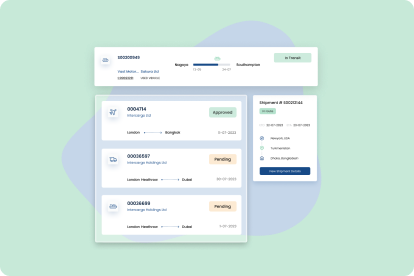
Keep all your data in one place which can be accessed from anywhere and anyplace

Let us help you 24/7 manage your supply chain needs

Back to Global Coverage

Australia Freight Forwarding Services
Air & Sea Freight Between Australia and the UK

Intercargo provides reliable freight forwarding services between Australia and the United Kingdom, helping businesses import and export cargo efficiently by air and sea.

Whether you are importing goods from Australia into the UK, exporting products from the UK to Australia, or managing regular international shipments, our experienced freight forwarding team provides complete end-to-end logistics solutions. From collection and customs clearance to final delivery, we manage every stage of the shipment process.
Logistics solutions
Air Freight Australia to UK
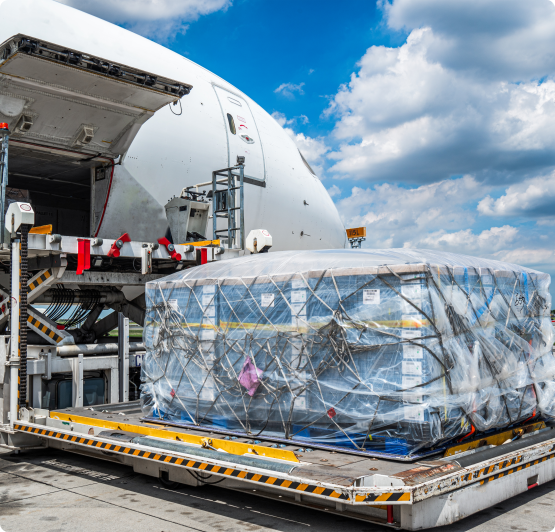
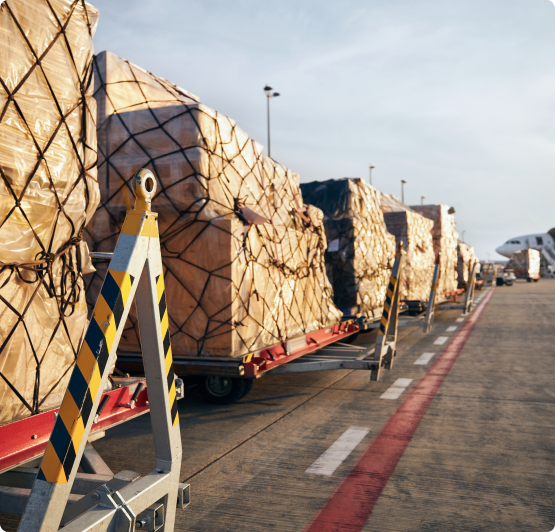
When speed matters, our Australia air freight services provide fast, secure and reliable transportation between Australia and the United Kingdom.
We arrange air freight through major Australian airports including Sydney Airport (SYD), Melbourne Airport (MEL), Brisbane Airport (BNE), Perth Airport (PER) and Adelaide Airport (ADL), with UK arrivals through London Heathrow, London Stansted, Manchester Airport, Birmingham Airport and East Midlands Airport.

Our air freight solutions include:

  • Air freight from Australia to the UK
  • Express and economy air cargo
  • Door to door delivery
  • Time critical shipments
  • Air freight from the UK to Australia
  • Airport to airport services
  • Customs clearance support
  • High value and commercial cargo

Whether you need urgent delivery of electronics, consumer goods, fashion products, industrial equipment or commercial cargo, our air freight specialists can provide the most efficient solution.
Logistics solutions
Sea Freight Australia to UK
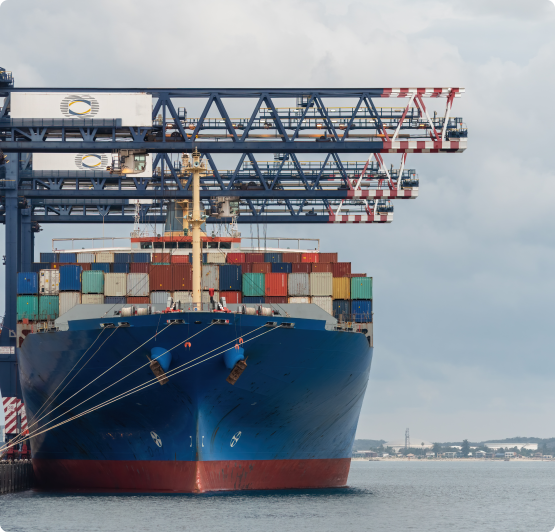
For larger shipments and cost-effective transportation, our sea freight services provide dependable shipping solutions between Australia and the UK.
We regularly arrange cargo movements through major Australian ports including Port Botany (Sydney), Port of Melbourne, Port of Brisbane, Fremantle Port (Perth) and Port Adelaide, with UK arrivals through Port of Felixstowe, Southampton, London Gateway, Liverpool, Tilbury and Immingham.

Our air freight solutions include:

  • Full Container Load (FCL)
  • Port to port shipping
  • Customs documentation
  • Project cargo
  • Less than Container Load (LCL)
  • Door to door logistics
  • Cargo insurance
  • Oversized and heavy lift shipments

Whether shipping machinery, mining equipment, commercial products, manufacturing equipment or retail stock, we can tailor a sea freight solution to suit your budget and transit requirements.
Logistics solutions
Import from Australia to the UK
Intercargo helps UK businesses import products and cargo from Australia through a fully managed freight forwarding service.

Our import services include:

  • Supplier coordination
  • Air and sea freight transportation
  • Duty and VAT guidance
  • Final delivery throughout the UK
  • Collection from Australia factories, warehouses and commercial premises
  • UK customs clearance
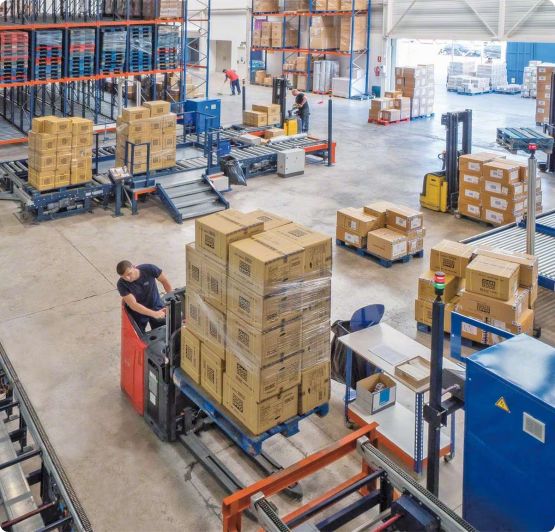
  • Warehousing and distribution

We regularly support imports including:

  • Electronics and semiconductors
  • Medical devices
  • Manufacturing components
  • Industrial equipment
  • Consumer goods
  • Machinery
  • Food and beverage products
Our experienced team ensures your cargo moves efficiently from Australia to the UK while remaining compliant with all customs and import requirements.
Logistics solutions
Export from the UK to Australia
We also help UK businesses export goods to customers, distributors and partners throughout Australia. Whether shipping to Sydney, Melbourne, Brisbane, Perth, Adelaide, Canberra or Hobart, our export specialists can arrange a seamless freight solution by air or sea.
Our export services include:

  • Air freight exports
  • Export documentation
  • Cargo insurance
  • Commercial and industrial shipments
  • Sea freight exports
  • Customs compliance
  • Door-to-door delivery

From single shipments to regular freight movements, we provide scalable logistics solutions designed around your business requirements.
Logistics solutions
Customs Clearance & Freight Forwarding
Successful international shipping depends on accurate customs documentation and compliance. Intercargo provides:

  • Import customs clearance
  • Commodity code guidance
  • Duty and tax assistance
  • End-to-end shipment visibility
  • Export customs clearance
  • Shipping documentation
  • Freight forwarding management

Our experienced freight forwarding team helps minimise delays and keeps your cargo moving smoothly between Australia and the United Kingdom.
Logistics solutions
Why Choose Intercargo for Australia Freight?
We support importers, exporters, manufacturers, distributors, retailers and e-commerce businesses moving cargo between Australia and the UK.
Air Freight And Sea Freight Specialists
Uk And Australia Trade Lane Expertise
Import And Export Solutions
Customs Clearance Support
Door To Door Logistics
Dedicated Account Management
Global Carrier Network
Competitive Freight Rates
Get a Australia Freight Quote

Looking for air freight from Australia to the UK, sea freight from Australia to the UK, or export services from the UK to Australia? Contact Intercargo today for a tailored freight forwarding quotation and expert advice on the most efficient shipping solution for your cargo.
Logistics solutions
Latest News & Updates

Aerospace shipments face growing supply chain capacity crunch

Aerospace shipments are facing a growing capacity squeeze, and the bottleneck is no longer just in the air. Marcelo Riso, VP and global product manager aerospace at Kuehne+Nagel, said the internationalisation of aircraft maintenance was making transportation increasingly critical. He told The Loadstar: "Even routine shipments are now carrying service expectations above standard airfreight levels, because the cost of transport is relatively small compared with the consequences of a parts shortage or operational disruption." The capacity challenge, however, varies considerably depending on what is being moved. Engines are particularly exposed because they depend on widebody main-deck freighter capacity, which is inherently more limited. Aircraft-on-ground (AOG) shipments and other components are more commonly moved in the lower-deck belly holds of passenger aircraft. Mr Riso reckons belly capacity can be more dependable for time-critical aerospace shipments because passenger demand supports frequent and predictable schedules. Freighter operations, by contrast, are more exposed to changes in demand and network deployment. The problem is that aerospace is no longer competing only with traditional airfreight markets. Mr Riso pointed to the e-commerce boom as an earlier source of pressure on freighter capacity, while demand associated with AI infrastructure was now creating another significant competitor, as well as perishables and pharmaceuticals. Large, specialised equipment also competes directly with engines for limited capacity, while semiconductor shippers can command premium allocations, a situation that could become more complicated as the composition of passenger fleets changes. Mr Riso noted the growth of ultra-long-range narrowbodies, such as the B737MAX and A321XLR, which are beginning to take market share from widebodies. The impact on belly capacity is currently marginal, because the aircraft are largely operating alongside widebodies. But if narrowbodies begin replacing widebody services on more routes, the amount of cargo space available could fall. The vulnerability of aerospace supply chains has also been exposed by geopolitical disruption. Mr Riso said a large proportion of widebody freighter capacity was provided by Middle Eastern carriers, meaning disruption to their operations can have effects far beyond the region. When airspace closures forced carriers to suspend or reduce operations, markets including India and Asia-Pacific experienced disruption to routing and capacity availability. Engines and other critical aerospace components were particularly exposed. But the bigger issue, Mr Riso argues, is that the definition of logistics capacity is changing. He said: "Capacity is no longer just an airline issue; it's an end-to-end infrastructure issue." Indeed, in some markets aircraft capacity may no longer be the principal constraint. Ground handling resources, specialist trucking, customs processes, and airport infrastructure can all restrict the movement of high-value aerospace shipments. Manpower is another vulnerability. Driver shortages across Europe and North America can compound delays at loading and unloading points, while limited visibility remains a problem when tracking systems depend on delayed manual updates. For aerospace operators and MRO providers, the timing of these disruptions is particularly important because shipments can already be late before they even enter the transportation phase. Mr Riso said: "Aerospace supply chains and parts availability are already under significant pressure, so by the time a shipment reaches the transportation phase, it's often already running late." A further transport delay can quickly affect aircraft availability and maintenance schedules. The response, therefore, is less about relying on a single source of capacity and more about building flexibility into the logistics network. He advises aerospace supply chains should limit reliance on any single carrier, route, or station, with alternative processes and routing options planned in advance. "Proximity is not always the best solution; access to reliable airfreight capacity can be more important," he added.

Source: theloadstar.com

Read more

Most in logistics still can't make AI pay - the few that can think smaller

Key takeaway: BCG says just 13% of logistics firms see real returns from AI. But this week's crop of deployments suggests the winners aren't chasing grand visions, they're automating the boring stuff. The gap between what logistics executives say about artificial intelligence and what they can actually show for it has become difficult to ignore. A Boston Consulting Group (BCG) report published earlier this month found that while 97% of logistics leaders call AI a strategic priority, only 13% ...

Source: theloadstar.com

Read more

Asia-US East Coast spot rate climb stalls - but is it just a blip?

Indices appear uncertain how to price spot rates this week, but what seems clear is that the Asia-US East Coast trade's substantive growth trajectory of recent weeks has hit a bump - the question is whether this is a blip or something more transformative. According to Drewry's World Container Index (WCI), spot pricing on its Shanghai-New York routing dropped 2% week on week, hitting $9,333 per 40ft, while the traditionally more resilient Shanghai-LA route went from 9% growth last week to flat this week, at $6,818 per 40ft. Indications are that the east coast dip may have been something of a blip, Drewry noting it expects resilience in demand, and the ability of the carriers to manage capacity will mean "freight rates remain less volatile next week". However, sources questioned the logic, particularly with the push to resume Red Sea transits picking up; one source telling The Loadstar: "When that happens, there will be a surge of capacity on the market and rates will crash." Another source concurred, asking: "Why are carriers doing this? It has been their lifeline since the post-pandemic rates collapse, so if they are all going back to the Red Sea, we can surely expect to witness a massive drop off in rates." Not all indices agree and, offering a counterpoint to the negativity of the WCI, Freightos's FBX suggests that the Asia-US East Coast trade's growth rate may be slowing, but its numbers suggest pricing has yet to go into reverse. The FBX pointed out that growth on the trade was up 3% week on week, for an average of $9,576 per 40ft, and well ahead of the $5,073 the index put the pricing at just three months ago, with Asia-US West Coast up 1%, to $7,491 per 40ft. Linerlytica said: "East coast rates continue to outperform, with capacity remaining in short supply that has been worsened by compounding congestion at Chinese ports and tightening draught restrictions on the Panama Canal. "Transpacific demand continues to edge upwards, with the strength continuing into September, in contrast to the sluggish European demand where reduced capacity, with vessels pushed out of position, failed to lift rates." On Asia-Europe trades, the theme was one of continuity, with spot rates again falling. Shanghai-Rotterdam was 3% down week on week, to $4,287 per 40ft and Shanghai-Genoa down 2%, to $4,866 per 40ft. Vespucci Maritime CEO Lars Jensen said: "The post-peak slow downward slide continued for the seventh consecutive week. Over these weeks North Europe rates are down 13% and Mediterranean rates are down 25%." Drewry described the east-west container freight market as being "racked by uncertainty" amid the geopolitical and operational pressures that are continuing to reshape shipping routes - the issues in the Strait of Hormuz the most pronounced. Things are not being helped by low water levels along the Rhine. "We did have some rain this week, though," one source told The Loadstar. Consequently, Drewry advised shippers: "With carriers adjusting capacity through blanked sailings, shippers should book early and allow additional lead time to minimise rollover and transit-delay risks." Linerlytica added: "The difference in cargo strength is expected to last for at least one more month, with transpacific rates expected to hold at current elevated levels." One source active in the Asian markets told The Loadstar they were expecting much the same.

Source: theloadstar.com

Read more

Privacy Preference Center

This website uses cookies and similar technologies, (hereafter “technologies”), which enable us, for example, to determine how frequently our internet pages are visited, the number of visitors, to configure our offers for maximum convenience and efficiency and to support our marketing efforts. These technologies incorporate data transfers to third-party providers based in countries without an adequate level of data protection (e. g. United States). For further information, including the processing of data by third-party providers and the possibility of revoking your consent at any time, please see your settings under “Consent Preferences” and our


Privacy Notice


Privacy Preference Center

Strickly Necessary Cookies
Always Active

Performance Cookies

Functional Cookies

Targeting Cookies