We understand the ever changing needs of our customers

we provide a high level of service dedicated to fulfilling all your shipping requirements

Watch Video
Road Freight

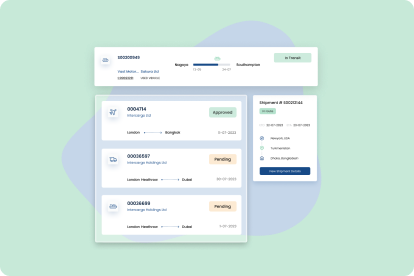
Keep all your data in one place which can be accessed from anywhere and anyplace

Let us help you 24/7 manage your supply chain needs

Back to Global Coverage

USA Freight Forwarding Services
Air & Sea Freight Between USA And The UK

Intercargo provides reliable freight forwarding services between the USA and the United Kingdom, helping businesses import and export cargo efficiently by air and sea.

Whether you are importing goods from the USA into the UK, exporting products from the UK to the USA, or managing regular international shipments, our experienced freight forwarding team provides complete end-to-end logistics solutions. From collection and customs clearance to final delivery, we manage every stage of the shipment process.
Logistics solutions
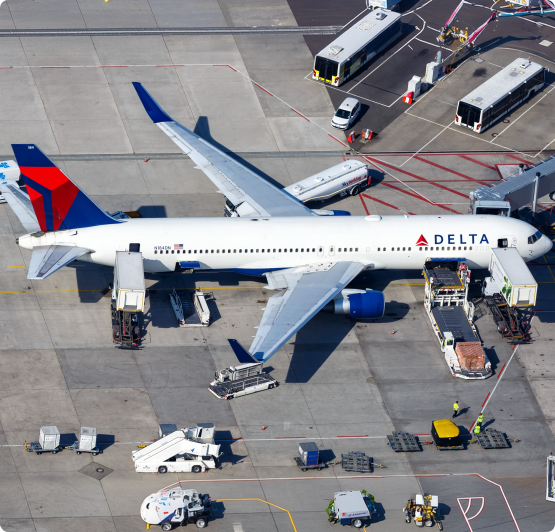
Air Freight USA to UK
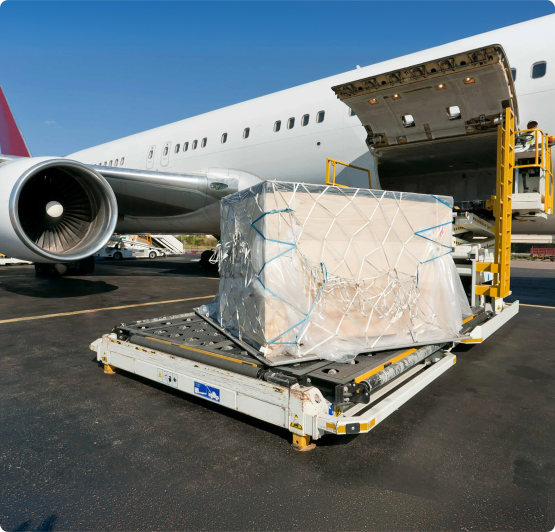
When speed matters, our USA air freight services provide fast, secure and reliable transportation between the USA and the United Kingdom.
We arrange air freight through major US airports including John F. Kennedy International Airport (JFK), Chicago O'Hare International Airport (ORD), Los Angeles International Airport (LAX), Hartsfield-Jackson Atlanta International Airport (ATL), Miami International Airport (MIA) and Dallas Fort Worth International Airport (DFW), with UK arrivals through London Heathrow, London Stansted, Manchester Airport, Birmingham Airport and East Midlands Airport.

Our air freight solutions include:

  • Air freight from USA to the UK
  • Express and economy air cargo
  • Door-to-door delivery
  • Time-critical shipments
  • Air freight from the UK to USA
  • Airport-to-airport services
  • Customs clearance support
  • High-value and commercial cargo

Whether you need urgent delivery of electronics, manufacturing components, retail stock, machinery or commercial goods, our air freight specialists can provide the most efficient solution.
Logistics solutions
Sea Freight USA to UK
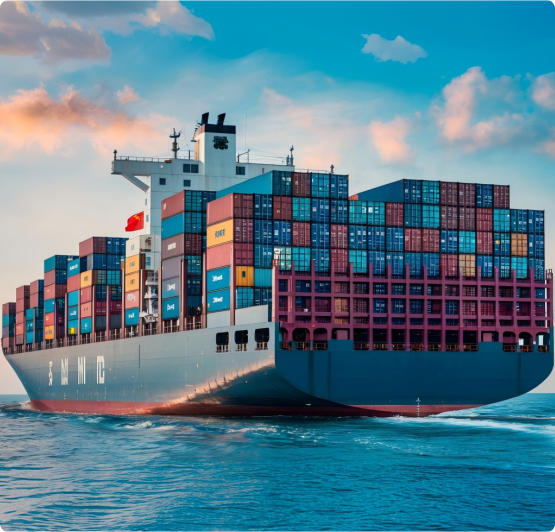
For larger shipments and cost-effective transportation, our sea freight services provide dependable shipping solutions between the USA and the UK.
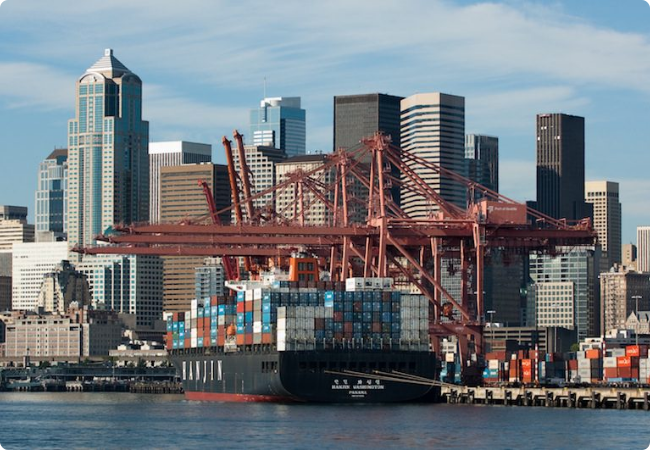
We regularly arrange cargo movements through major US ports including Port of Los Angeles, Port of Long Beach, Port of New York and New Jersey, Port of Savannah, Port of Houston and Port of Norfolk, with UK arrivals through Port of Felixstowe, Southampton, London Gateway, Liverpool, Tilbury and Immingham.
Our sea freight services include:

  • Full Container Load (FCL)
  • Port-to-port shipping
  • Customs documentation
  • Project cargo
  • Less than Container Load (LCL)
  • Door-to-door logistics
  • Cargo insurance
  • Oversized and heavy-lift shipments

Whether you are shipping machinery, consumer products, electronics, industrial equipment, retail stock or manufacturing materials, our sea freight specialists deliver reliable, flexible and cost-effective shipping solutions between China and the UK.
Logistics solutions
Import from USA to the UK
Intercargo helps UK businesses import products and cargo from the USA through a fully managed freight forwarding service. Our import services include:

  • Supplier coordination
  • Air and sea freight transportation
  • Duty and VAT guidance
  • Final delivery throughout the UK
  • Collection from American factories, warehouses and commercial premises
  • UK customs clearance
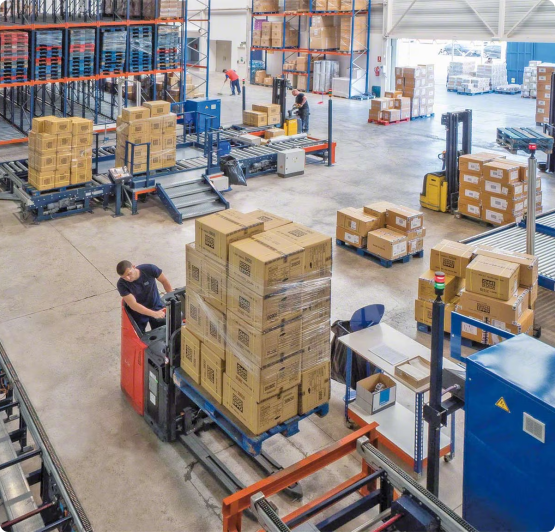
  • Warehousing and distribution

We regularly support imports including:

  • Electronics
  • Machinery
  • Manufacturing components
  • Consumer goods
  • Automotive parts
  • E-commerce products
  • Retail stock
  • Furniture
Our experienced team ensures your cargo moves efficiently from the USA to the UK while remaining compliant with all customs and import requirements.
Logistics solutions
Export from the UK to USA
We also help UK businesses export goods to customers, distributors and partners throughout the United States. Whether shipping to New York, Los Angeles, Chicago, Houston, Miami, Atlanta, Dallas, Seattle or San Francisco, our export specialists can arrange a seamless freight solution by air or sea.
Our export services include:

  • Air freight exports
  • Export documentation
  • Cargo insurance
  • Commercial & industrial shipments
  • Sea freight exports
  • Customs compliance
  • Door-to-door delivery

From single shipments to regular freight movements, we provide scalable logistics solutions designed around your business requirements.
Logistics solutions
Customs Clearance & Freight Forwarding
Successful international shipping depends on accurate customs documentation and compliance. Intercargo provides:

  • Import customs clearance
  • Commodity code guidance
  • Duty and tax assistance
  • End-to-end shipment visibility
  • Export customs clearance
  • Shipping documentation
  • Freight forwarding management

Our experienced freight forwarding team helps minimise delays and keeps your cargo moving smoothly between the USA and the United Kingdom.
Logistics solutions
Why Choose Intercargo for USA Freight?
We support importers, exporters, manufacturers, distributors, retailers and e-commerce businesses moving cargo between USA and the UK.
Air Freight And Sea Freight Specialists
Uk And Usa Trade Lane Expertise
Import And Export Solutions
Customs Clearance Support
Door To Door Logistics
Dedicated Account Management
Global Carrier Network
Competitive Shipping Rates
Get a USA Freight Quote

Looking for air freight from the USA to the UK, sea freight from the USA to the UK, or export services from the UK to the USA? Contact Intercargo today for a tailored freight forwarding quotation and expert advice on the most efficient shipping solution for your cargo.
Logistics solutions
Latest News & Updates

Shippers stressing over risks from Suez Canal and Red Sea transits

The return of Asia-Europe container shipping services to routing via the Red Sea and Suez Canal continues, despite the deteriorating security situation due to the escalating Houthi-Saudi conflict. While commercial shipping's close proximity to an active war zone may raise eyebrows, the signs are that most carriers will take the opportunity to traverse Suez while they can. Even an attack on CU Lines' 2,400 teu CUL Klang last week was not enough to deter other carriers. The vessel was reported to have come under small arms fire in the southern area of the Red Sea. "Drewry is not privy to carriers' internal risk assessments, but irrespective of our own reservations about the ongoing security risk, we cannot deny the evidence that lines are returning to Suez ahead of our projected timeline," writes Drewry's head of container research Simon Heaney in a new analysis. "As such, we have adjusted our base case assumptions to a phase-back of Suez transits starting July/August, reaching 80% of pre-diversion level by February 2027. "We believe it will stay at that level through the forecast horizon, as carriers will want to retain optionality for network resilience purposes," he adds. However, he also notes that the cost implications for routing a vessel via Suez, compared with diverting round the Cape of Good Hope, may not be as wide as many think, despite the shorter two-week transit time and reduced fuel spend. "Drewry's slot cost comparison shows only a marginal economic benefit to using Suez, with a saving of approximately $1m per round-voyage, or $43 per slot, when comparing two services deploying ships of 24,000 teu that use either Suez or the Cape in both directions. "However, our calculations do not factor-in war-risk premiums, as this information is not readily available, nor the fact that the Suez Canal is known to commonly offer discounts to carriers to tempt them back. "Both line items are highly dynamic; war-risk insurance is often negotiated voyage by voyage, while any canal discounts are discretionary," he adds. This can cause particular problems for shippers, however, according to Antonis Rigalos, managing partner at ShiftX, a network of shippers that jointly negotiate with carriers on long-term contracts. He claimed that some routing decisions were taken on an ad hoc basis that could leave shippers exposed in terms of insurance cover "A couple of these carriers are doing ad hoc routings via Suez, and that creates a little bit of stress for shippers because some of the insurers don't have Suez coverage, and they have to apply for that," he told last week's Asia-Europe webinar produced by the Journal of Commerce. "So if the routing is set for Cape of Good Hope and suddenly the carrier decides to go via Suez, that insurance needs to be obtained on a short notice, and that creates stress for BCOs. "It needs to be plannable; it needs to be safe and consistent," he added. He noted that some services, such as CMA CGM's Japan-North Europe OCR string, was "clearly advertised" as a transSuez service. "It is clearly advertised with a fast transit time to Europe - 30 days transit time that can be chosen by shippers." According to Mr Heaney, if the war-risk premium charged by insurers to a carrier was 0.3% of the hull value of a 24,00 teu boxship with a newbuild price of $225m, that would lead to an extra 1.35m in insurance premiums for a round-trip voyage. "That on its own would tip the economic advantage over to the Cape routing, just," he adds. Of course, carriers have also begun to introduce Suez Canal and Red Sea surcharges to cover that cost - at the end of September, MSC announced it was extending its Piracy Risk and Suez Canal surcharges through October, which amount to $91 per teu ($55 per teu piracy risk and $36 per teu Suez Canal), meaning a full loaded 24,000 teu ship could, theoretically, pay $2.18m in surcharges. "It should be noted that insurers are known to offer rebates of around 50% for voyages that are safely completed with no incident, further muddying the calculations," Mr Heaney adds. However, Mr Rigalos also said that reports from ShiftX's BCO members were that current extra insurance costs for transSuez shipments for shippers had yet to become overly onerous. "I think it's manageable. What I understood from the BCOs is that it's not a big impact so far. "They only need to have that insurance in case something happens due to the Houthis and so on - it is important that cargo is insured, but the costs are manageable," he said.

Source: theloadstar.com

Read more

Strong US import demand will support transpacific rates till new year

Transpacific container freight rates are likely to remain higher than on Asia-Europe for some time, as stronger economic conditions in the US support import demand and weaker European growth weighs on cargo volumes and freight rates. Evergreen general manager Wu Kuang Hui said the rate divergence had become increasingly pronounced: "strong on US routes, weak on Europe routes". And he said on Friday he expected the stronger US market to continue supporting transpacific rates at a premium to Asia-Europe rates, and there was "no reason to be pessimistic" about the US routes before the lunar new year 2027 as "there are record-high import volumes at several major US ports, low inventory levels, and optimistic consumer demand". US imports from the Far East have grown about 5.1%, but volumes to Europe have increased more rapidly, by 12.2%. However, the weaker European economic backdrop has translated into reduced pricing power on Asia-Europe trades. European spot volumes have increased significantly, but freight rates that surged in April, following the US-Iran conflict, have declined steadily since July. On Friday, the Shanghai Containerised Freight Index showed Shanghai-US east and west coast rates relatively stable, at $10,524 and $7,584 per 40ft, respectively. Shanghai-Europe rates continued to decline, losing 3%, to $2,274 per teu. The gradual return of container vessels to the Red Sea and Suez Canal is adding further downward pressure on Asia-Europe rates by restoring effective capacity. Although geopolitical risks in the Red Sea have not been fundamentally resolved, carriers are increasingly resuming the routings. By contrast, transpacific capacity remains supported by robust US import demand. Mr Wu noted that US spot rates were significantly higher than negotiated rates in Q4 last year, and expects long-term contract prices next year to exceed this year's. Potential US tariff adjustments could provide additional support. Mr Wu said: "Importers could receive about $160bn in tax rebates, potentially allowing lower end-product prices and higher inventory levels, which could stimulate further imports. "The US outlook is not without risks. A potential inflation-driven interest-rate hiking cycle could eventually weaken terminal demand, making the second quarter of next year less certain. Nevertheless, we expect the near-term outlook to remain favourable." Meanwhile, congestion is helping absorb capacity across both trades. Singapore's port utilisation has exceeded 90%, while severe congestion at Shanghai and Ningbo has contributed to vessel bunching and schedule delays. Evergreen's strong market outlook comes amid a sharp increase in the carrier's revenue. In September, consolidated revenue reached TWD49.7bn ($1.56bn) up 64% year on year, while cumulative revenue for the first nine months of 2026 rose 15%, to TWD338.4bn ($10.61bn). Mr Wu said booking conditions through November were expected to remain favourable, followed by another seasonal increase in December, ahead of Chinese New Year. Evergreen operates 242 vessels with capacity of 2.04m teu, giving the seventh-largest shipping line a 5.9% market share. The Taiwanese operator plans to expand the fleet to around 290 vessels, 2.74m teu, by 2030.

Source: theloadstar.com

Read more

Boeing remains busy with 777 freighter orders and deliveries

Data published by Boeing demonstrates that 777 freighter activity is still healthy following the Federal Aviation Administration's (FAA) decision to grant an emissions exemption for the cargo model. The aircraft manufacturer's order and delivery data for 2026 shows that six 777Fs have been ordered this year. Most recently, Ethiopian Airlines Group ordered two 777Fs in September, as part of a wider order for eight new generation Boeing 777-8Fs. The order followed earlier speculation that the carrier was considering purchasing up to 10 freighters from the US aircraft manufacturer. In June, China Airlines and China Southern Cargo also ordered two 777Fs each. On the deliveries front, Boeing's data shows that 20 of the model have been delivered so far this year, with FedEx and Air China Cargo both taking delivery of one aircraft last month. There are also a total of 38 unfilled orders to date. Boeing recorded a total of 15 777 freighter orders and 35 777 freighter deliveries last year. The longevity of Boeing's 777F was boosted in September when the FAA granted Boeing an emissions exemption for the aircraft model that will enable it to continue selling them beyond the end of 2027. The decision by the FAA means that Boeing, which filed its emissions exemption request in December and had requested that the exemption be approved by 1 May, can sell 35 more 777Fs that will be eligible for a Certificate of Airworthiness. "This exemption goes into effect on January 1, 2028, and applies to issuance of the first certificates of airworthiness for up to thirty-five 777F airplanes through January 1, 2031, unless sooner superseded or rescinded," said the FAA decision document published on 16 September. Without an exemption, these aircraft would not be eligible for a Certificate of Airworthiness from 1 January 2028 because they do not comply with fuel efficiency limits to curb emissions. The approval gives the widebody freighter market a huge boost as the sector was facing a supply shortage. As well as meeting continued 777F demand, the exemption will also enable Boeing to bridge the gap until its new generation 777-8 freighter comes to market.

Source: aircargonews.net

Read more

Privacy Preference Center

This website uses cookies and similar technologies, (hereafter “technologies”), which enable us, for example, to determine how frequently our internet pages are visited, the number of visitors, to configure our offers for maximum convenience and efficiency and to support our marketing efforts. These technologies incorporate data transfers to third-party providers based in countries without an adequate level of data protection (e. g. United States). For further information, including the processing of data by third-party providers and the possibility of revoking your consent at any time, please see your settings under “Consent Preferences” and our Privacy Notice.


Manage Consent Preferences
Strictly Necessary Cookies
Always Active

Performance Cookies

Functional Cookies

Targeting Cookies