We understand the ever changing needs of our customers

we provide a high level of service dedicated to fulfilling all your shipping requirements

Watch Video
Road Freight

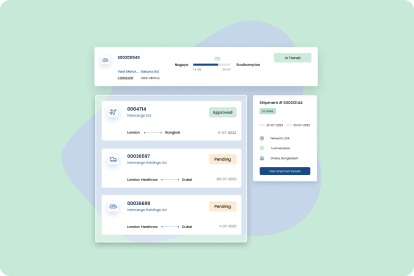
Keep all your data in one place which can be accessed from anywhere and anyplace

Let us help you 24/7 manage your supply chain needs

Back to Global Coverage

Kuwait Freight Forwarding Services
Air & Sea Freight Between Kuwait and the UK

Intercargo provides reliable freight forwarding services between Kuwait and the United Kingdom, helping businesses import and export cargo efficiently by air and sea.

Whether you are importing goods from Kuwait into the UK, exporting products from the UK to Kuwait, or managing regular international shipments, our experienced freight forwarding team provides complete end-to-end logistics solutions. From collection and customs clearance to final delivery, we manage every stage of the shipment process.
Logistics solutions
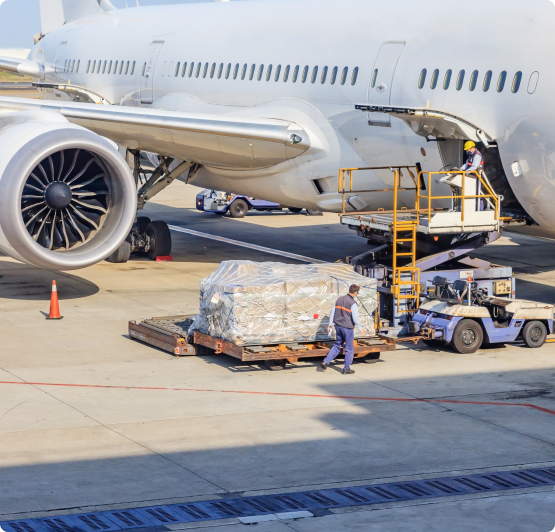
Air Freight Kuwait to UK
When speed matters, our Kuwait air freight services provide fast, secure and reliable transportation between Kuwait and the United Kingdom.
We arrange air freight through Kuwait International Airport (KWI), with UK arrivals through London Heathrow, London Stansted, Manchester Airport, Birmingham Airport and East Midlands Airport.

Our air freight solutions include:

  • Air freight from Kuwait to the UK
  • Express and economy air cargo
  • Door to door delivery
  • Time critical shipments
  • Air freight from the UK to Kuwait
  • Airport to airport services
  • Customs clearance support
  • High value and commercial cargo

Whether you need urgent delivery of industrial equipment, automotive parts, electronics, retail stock or commercial goods, our air freight specialists can provide the most efficient solution.
Logistics solutions
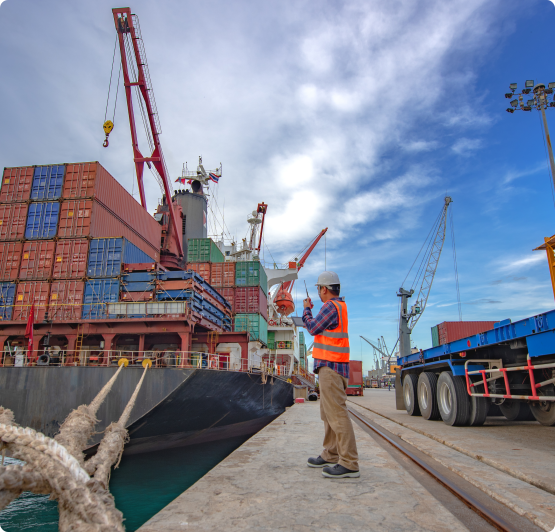
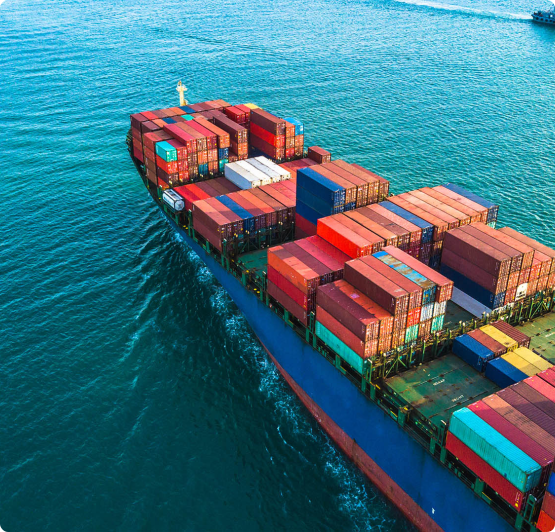
Sea Freight Kuwait to UK
For larger shipments and cost-effective transportation, our sea freight services provide dependable shipping solutions between Kuwait and the UK.
We regularly arrange cargo movements through Shuwaikh Port and Shuaiba Port, with UK arrivals through Port of Felixstowe, Southampton, London Gateway, Liverpool, Tilbury and Immingham.

Our sea freight services include:

  • Full Container Load (FCL)
  • Port to port shipping
  • Customs documentation
  • Project cargo
  • Less than Container Load (LCL)
  • Door to door logistics
  • Cargo insurance
  • Oversized and heavy lift shipments

Whether shipping machinery, construction materials, commercial products, manufacturing equipment or retail stock, we can tailor a sea freight solution to suit your budget and transit requirements.
Logistics solutions
Import from Kuwait to the UK
Intercargo helps UK businesses import products and cargo from Kuwait through a fully managed freight forwarding service.

Our import services include:

  • Supplier coordination
  • Air and sea freight transportation
  • Duty and VAT guidance
  • Final delivery throughout the UK
  • Collection from Kuwaiti factories, warehouses and commercial premises
  • UK customs clearance
  • Warehousing and distribution

We regularly support imports including:

  • Petrochemical products
  • Machinery
  • Commercial goods
  • Plastics and polymers
  • Aluminium products
  • Industrial equipment
  • Manufacturing components
Our experienced team ensures your cargo moves efficiently from Kuwait to the UK while remaining compliant with all customs and import requirements.
Logistics solutions
Export from the UK to Kuwait
We also help UK businesses export goods to customers, distributors and partners throughout Kuwait. Whether shipping to Kuwait City, Al Ahmadi, Hawalli, Farwaniya, Jahra or other commercial and industrial locations across Kuwait, our export specialists can arrange a seamless freight solution by air or sea.
Our export services include:

  • Air freight exports
  • Export documentation
  • Cargo insurance
  • Commercial and industrial shipments
  • Sea freight exports
  • Customs compliance
  • Door-to-door delivery

From single shipments to regular freight movements, we provide scalable logistics solutions designed around your business requirements.
Logistics solutions
Customs Clearance & Freight Forwarding
Successful international shipping depends on accurate customs documentation and compliance. Intercargo provides:

  • Import customs clearance
  • Commodity code guidance
  • Duty and tax assistance
  • End-to-end shipment visibility
  • Export customs clearance
  • Shipping documentation
  • Freight forwarding management

Our experienced freight forwarding team helps minimise delays and keeps your cargo moving smoothly between Kuwait and the United Kingdom.
Logistics solutions
Why Choose Intercargo for Kuwait Freight?
We support importers, exporters, manufacturers, distributors, retailers, construction companies and e-commerce businesses moving cargo between Kuwait and the UK.
Air Freight And Sea Freight Specialists
Uk And Kuwait Trade Lane Expertise
Import And Export Solutions
Customs Clearance Support
Door To Door Logistics
Dedicated Account Management
Global Carrier Network
Competitive Freight Rates
Get a Kuwait Freight Quote

Looking for air freight from Kuwait to the UK, sea freight from Kuwait to the UK, or export services from the UK to Kuwait?
Contact Intercargo today for a tailored freight forwarding quotation and expert advice on the most efficient shipping solution for your cargo.
Logistics solutions
Latest News & Updates

Freighter capacity on the move as airlines redraw global networks

Airlines are reshaping freighter networks as uneven demand and a shortage of available aircraft make the deployment of existing capacity increasingly important. Airports, too, are having to fight harder to attract capacity. The latest WorldACD figures point to an increasingly fluid freighter market, with aircraft shifting between tradelanes in response to changes in demand. WorldACD said the slowdown in ecommerce traffic into Europe had prompted a "quick re-allocation of freighter capacity from Asia Pacific-Europe to transpacific sectors". Rather than a wholesale expansion in available lift, global air cargo capacity has remained remarkably stable, fluctuating within a range of just plus or minus 1% week on week since late June. In week 36, worldwide capacity slipped 1%, with Asia Pacific and North American capacity both down 1% and Central and South America down 3%. WorldACD said the relatively static global capacity picture partly reflected continuing supply chain problems affecting the output of new widebody aircraft, while the "re-deployment of freighters from slower to more active markets" had helped keep rates relatively stable. That approach to capacity is increasingly visible in carrier schedules and partnerships. ANA Group, which is preparing to combine ANA Cargo, Nippon Cargo Airlines (NCA) and NCA Japan into a single cargo airline next year, has been adjusting its freighter operation in response to what it describes as "changing market conditions". For the winter season, NCA's separate Narita-Dallas and Narita-New York routes are being restructured into a combined Narita-Dallas-New York operation, while frequencies on the Narita-Singapore-Bangkok route are being increased. The group is also leaving room to add charter and extra-section flights as demand dictates, saying it will use "agile network optimisations" to respond to customer requirements. The strategy will become increasingly important after the three cargo businesses are integrated on 1 April next year. ANA announced this week that the new operation would be branded ANA Nippon Cargo, with the corporate name subsequently scheduled to change to ANA Nippon Cargo Airlines. The group intends to combine dedicated freighters with the belly capacity of ANA's expanding passenger network to capture cargo flows between Asia, Europe and North America. But the group's network reach is not limited to its own aircraft - it also uses Mexico's mas, via a block space agreement, for services from Los Angeles to Mexico City's Felipe Ángeles International Airport (NLU) and Guadalajara, while mas takes space on NCA flights between Los Angeles and Narita. Mas typifies airlines trying to extract more from its fleet of just five A330 freighters while struggling to source additional aircraft. The carrier's fleet is currently spread across three areas of operation: an Americas network connecting Los Angeles with South America through NLU; four weekly flights to China; and European flying from Zaragoza for a major fashion retailer through Galistair, in which mas owns a 49% stake. Chief executive Robert Van De Weg said last month that mas wanted to add one or two widebody freighters this year and expand its fleet to eight-to-10 aircraft by 2030, but acknowledged the shortage of suitable aircraft was making expansion difficult. Rather than continue adding destinations, he said the immediate priority was to increase frequencies on its existing network. "We would like to add more stations, but for now I think we are good with our stations spread until we can grow," said Mr Van De Weg. "I think the prime purpose now is not to add new stations but to increase frequencies, but for that again we need the fleet growth." Cathay Cargo, meanwhile, is also changing where and how it deploys freighter capacity. It said it was adding additional freighter lift to the Americas from September to meet current demand and prepare for the fourth quarter, while a leased A330 converted freighter will join its operation later this year. The aircraft will be operated on Cathay's behalf by subsidiary Air Hong Kong, in a new operating model for the two carriers, and will be aimed at increased regional demand for general cargo. Other carriers are finding opportunities at less traditional freighter gateways. Air China Cargo this month added a twice-weekly link between Ürümqi and Glasgow Prestwick, adding to its services between the Scottish airport and Guangzhou, Chengdu and Shanghai. Prestwick now has 16 scheduled weekly services to and from mainland China and said its cargo tonnage had quadrupled year on year. The airport is also seeking to build traffic in the opposite direction. Some 1.78m kg of Scottish salmon was exported through Prestwick in the first half of the year, and the airport sees the Ürümqi service as offering further opportunities for seafood and whisky exports. Qatar Airways Cargo has similarly moved into a new market, launching a weekly 777 freighter service from Doha to Helsinki via Budapest earlier this month, giving Finland its first dedicated scheduled cargo connection to Asia. For airports seeking a share of this shifting capacity, however, simply having the infrastructure available may no longer be sufficient. Navi Mumbai recently introduced substantial incentives for international operators, including the 90% first-year reduction in landing charges for new international freighter services and a 50% reduction in year two. The airport had argued that international airlines were proving reluctant to commit capacity amid high operating costs and wider uncertainty, prompting India's Airports Economic Regulatory Authority to revise the incentive structure. Relatively new or secondary gateways can offer carriers new network possibilities, but they still have to persuade airlines that deploying scarce aircraft there makes commercial sense. And carriers are now having to make their freighters work harder as the freighter crunch begins to bite.

Source: theloadstar.com

Read more

Boeing to continue producing 777Fs after FAA approves emissions exemption

The Federal Aviation Administration (FAA) has granted Boeing an emissions exemption for its 777 freighter that will enable the aircraft manufacturer to continue selling them beyond the end of 2027. The decision by the FAA means that Boeing, which filed its emissions exemption request in December and had requested that the exemption be approved by 1 May, can sell 35 more 777Fs that will be be eligible for a Certificate of Airworthiness. The approval gives the widebody freighter market a huge boost as the sector was facing a supply shortage. As well as meeting continued 777F demand, the exemption will also enable Boeing to bridge the gap until its new generation 777-8 freighter comes to market. "This exemption goes into effect on January 1, 2028, and applies to issuance of the first certificates of airworthiness for up to thirty-five 777F airplanes through January 1, 2031, unless sooner superseded or rescinded," said the FAA decision document published on 16 September. In last year's petition document for the 777F emissions exemption, Boeing had pointed out that although the 777-8F will operate within fuel-efficiency limits, the model would not yet be on the market when the 777F could no longer be certified by the FAA. The FAA added in the exemption approval document that it acknowledged "the practical benefits of permitting limited 777F production until its successor is available". The 777-8F was originally anticipated to come to market in 2027, but in October 2024, Boeing announced it would delay launch until 2028. Boeing recorded a total of 15 777 freighter orders and 35 777 freighter deliveries last year. The company's order and deliveries data shows 18 777Fs have been delivered to customers so far this year.

Source: aircargonews.net

Read more

Continued fuel price shocks leave emergency surcharges stuck in overdrive

Soaring oil prices are sending a further wave of fuel increases through global logistics, leaving shippers exposed not only to higher transport costs, but to emergency pricing mechanisms that can change their freight bills from one week to the next. With oil above $100 a barrel amid continuing conflict in the Middle East, fuel surcharges are climbing across all transport modes. But perhaps more significant is what has happened to the way some of those costs are being passed on. Weekly fuel adjustments introduced as exceptional measures earlier in the energy crisis have, in some markets, now been running for around six months - and the latest oil-price surge is pushing them sharply higher again. Transport Intelligence (Ti) analyst Thomas Cullen noted this week that oil prices had increased by around $50 a barrel over the past year, with November Brent trading at around $107. And the threats to supply extend beyond declining vessel traffic through the Strait of Hormuz. Ti noted that attacks had also targeted the Abqaiq-Yanbu pipeline, Saudi Arabia's most important means of exporting oil without using Hormuz, while Ukrainian attacks were putting further pressure on Russian oil supplies. Although bunker fuel supplies have so far remained relatively robust, Ti warned that could change over the coming months, arguing that low reserves and disrupted supply meant the oil market appeared to be approaching a "crisis point". The prolonged volatility is visible in the mechanisms freight operators are using to recover their costs. DHL Aviation's ex-Hong Kong long-haul cargo fuel surcharge will rise to HK$12.30 ($1.58) per kg from 21 September, from HK$11.30 this week and HK$6.80 in early July - an increase of more than 80% in around 11 weeks. The latest calculation is based on an IATA Asia and Oceania jet fuel price of $169 a barrel. Normally DHL's ex-Hong Kong surcharge is calculated monthly, but when the jet fuel index exceeds $100.99 a barrel it moves to weekly calculations. The surcharge has remained on that weekly mechanism continuously since the end of March. A similar picture is apparent on the ground. Maersk told haulage customers in Greece in March that, because of the Middle East situation and rising fuel costs, it was adopting an "exceptional measure", replacing its monthly fuel surcharge review with weekly calculations. Six months later, that "exceptional" arrangement remains in place, with Maersk again telling Greek customers last week that it would review the surcharge weekly "for as long as it is necessary" to recover its increased costs. The truck surcharge is currently 15%. Its Nordic emergency inland fuel mechanism is also calculated weekly and the increases there show how quickly costs can move. In early July, Maersk's surcharge was just 1% in Denmark, 2% in Sweden and 5% in Estonia. From yesterday, those charges stood at 14%, 12% and 20%, respectively. DP World has similarly retained a weekly Emergency Fuel Escalator on UK road and intermodal transport. After falling to 4.72% in July, it has climbed back to 14.86% this week. The persistence of these mechanisms suggests one consequence of the prolonged energy crisis is a shortening of the lag between movements in oil markets and the prices paid by cargo owners. Monthly fuel mechanisms give transport providers greater exposure when energy prices move suddenly between adjustment dates. Weekly calculations allow them to recover increases much more quickly - but transfer that volatility equally rapidly to customers. But not all logistics companies have the same ability to pass it on. German road haulage association BGL yesterday warned chancellor Friedrich Merz that diesel had increased by around €0.60 per litre since the latest escalation in the Middle East. It calculated that a truck travelling 10,000km a month was consequently facing €1,800 in additional monthly costs. Across a 50-truck fleet, that would amount to €1.08m a year. But BGL said small- and medium-sized hauliers were frequently unable to, or could only partially, pass those increases on to customers, leaving operators in an already low-margin industry to absorb part of the shock themselves. It has called on the German government to remove what it describes as a double CO₂ burden on road transport and introduce a commercial diesel scheme, similar to those operating in several other EU countries, under which hauliers could reclaim part of the energy tax paid on fuel. That highlights an increasingly uneven allocation of fuel-price risk across logistics: large operators with formal indexation mechanisms can rapidly transfer much of the increase to customers, while smaller operators negotiating individual transport contracts may find themselves caught between rising diesel costs and resistance from shippers. And where the cost can be passed through, the problem moves further down the supply chain. Nishith Rastogi, founder and CEO of transportation management technology company Locus, acquired by IKEA's largest franchise retailer Ingka Group last year, warned today that higher oil prices and freight costs would put additional pressure on retail margins. "For retailers, this creates further pressure on margins and may require a combination of selective price increases, sourcing adjustments and more cautious replenishment planning," he said. "Energy and logistics shocks can move rapidly through the supply chain and ultimately influence the prices consumers see." Higher fossil-fuel costs could also alter the economics of how cargo is moved; Maersk's Nordic emergency surcharge does not apply to electric trucks or rail for example. Sustained fuel inflation improves the relative cost competitiveness of transport less exposed to oil prices. In shipping, research published today by the Global Centre for Maritime Decarbonisation and Boston Consulting Group shows how sensitive the alternative-fuel equation is to cost. Its modelling found methanol and ammonia could together meet 36% of global fleet energy demand by 2050 if the cost of green hydrogen fell to $2/kg, compared with just 4% if it remained at $3/kg. But for shippers the immediate impact of the oil shock is that fuel increases that once took weeks to reach freight bills, can increasingly arrive within days, while operators unable to pass them on face a direct hit to margins.

Source: theloadstar.com

Read more

Privacy Preference Center

This website uses cookies and similar technologies, (hereafter “technologies”), which enable us, for example, to determine how frequently our internet pages are visited, the number of visitors, to configure our offers for maximum convenience and efficiency and to support our marketing efforts. These technologies incorporate data transfers to third-party providers based in countries without an adequate level of data protection (e. g. United States). For further information, including the processing of data by third-party providers and the possibility of revoking your consent at any time, please see your settings under “Consent Preferences” and our


Privacy Notice


Privacy Preference Center

Strickly Necessary Cookies
Always Active

Performance Cookies

Functional Cookies

Targeting Cookies